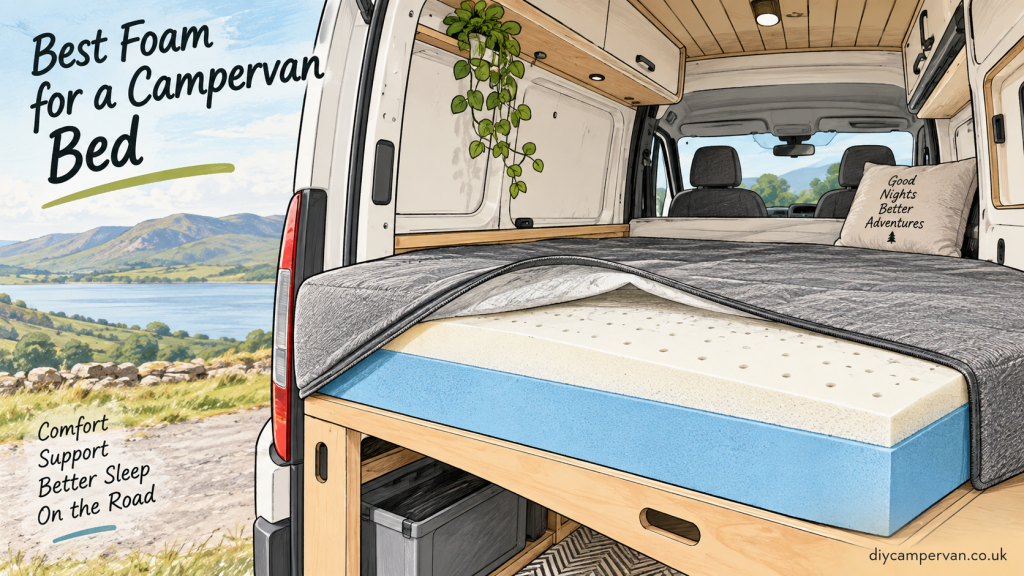
When I built the bed in our Transit, I did not start with a shiny new made-to-measure campervan mattress. We had been given a set of old caravan cushions, so I cut them down to fit the bed and re-sewed the covers.
I used an electric carving knife to cut the foam. It sounds slightly Heath Robinson, but it worked extremely well and gave me much cleaner cuts than trying to hack through thick foam with an ordinary knife.

That bed ended up measuring about 69 x 56 inches and was very comfortable. What I cannot tell you is the exact density or grade of those old caravan cushions, because I simply did not know it.
If I were buying new foam today, I would approach it differently: work out whether it is primarily a mattress, a seat that also becomes a bed, or a lightweight pop-top mattress, then choose the foam around that job.
Foam mattress or mattress topper?
They are two different problems.
If you already have a reasonably supportive campervan mattress or seat cushions and simply want another layer of comfort, you probably want our campervan mattress topper guide instead.
This article is about the foam that forms the mattress or cushions themselves.
Density and firmness are not the same thing
This is probably the most useful thing to understand before buying foam.
Density tells you how much foam material there is in a given volume. It is useful when judging the grade and likely durability of upholstery foam.
Firmness describes how hard or soft the foam feels when you sit or lie on it.
A high-density foam does not automatically have to feel rock hard, and a low-density foam is not automatically soft. So buying the highest density number you can find is not a sensible way to choose a comfortable mattress.
For a campervan bed, you want enough support to stop you sinking through the foam onto the bed base, but not so much firmness that it feels like sleeping on a park bench.
What type of campervan bed are you making?
A fixed bed
A fixed bed has the easiest job because the foam only needs to be a mattress. You can choose it for sleeping comfort without worrying about how it feels as a sofa during the day.
A good-quality reflex or high-density upholstery foam makes a sensible supportive base. If you like a softer mattress feel, a thinner memory-foam or similar comfort layer can sit on top rather than making the whole mattress from very soft foam.
A seat by day and bed by night
This is harder. The same cushions have to resist repeated sitting without collapsing, then form a comfortable sleeping surface when the bed is made up.
That is why specialist campervan foam suppliers tend to recommend a more durable supportive grade for rock-and-roll beds and dual-use cushions. If the seat is also a belted travelling seat, though, the foam and upholstery need to match the specification of that approved seat system rather than being chosen purely for sleeping comfort. You can always soften an ordinary non-travelling seat-bed with a removable topper, but it is difficult to make badly sagging seat foam supportive again.
Our original campervan seating and pullout-bed build shows the sort of layout where the seat cushions become part of the bed.
A pop-top mattress
Here, thickness and weight can matter as much as comfort. The mattress has to fit inside the closed roof and you do not want unnecessary foam weight making the roof harder to lift.
A lighter or slightly thinner supportive foam may therefore make more sense than copying the mattress construction from a fixed rear bed.
How thick should the foam be?
There is no magic thickness, because comfort depends on the foam grade, your weight, the bed base and how much space the mattress is allowed to occupy.
Around 100mm (4 inches) is a useful starting point for a supportive foam campervan mattress; current specialist guidance commonly starts around that thickness. A thicker mattress gives you more room to combine a supportive base with a softer top layer, but every extra centimetre also takes away headroom or storage space.
For a seat-bed, the finished cushion thickness also has to work when you are sitting at the table. A wonderfully deep mattress can make a terrible seat if it leaves your knees up around your ears.
If the mattress sits on solid plywood or closely spaced slats, also make sure you cannot feel the base through the foam when lying on your side. That is a much more useful test than chasing an arbitrary number.
Should you use memory foam?
Memory foam can make a very good comfort layer, but I would not automatically build the whole campervan mattress from it.
A supportive reflex-foam base with a thinner memory-foam layer on top gives you the structure underneath and pressure relief on the surface. It is also similar to the layered construction currently recommended by several specialist campervan foam suppliers.
If your existing cushions are already supportive but simply feel too hard or have uncomfortable joins, a separate topper may be the easier answer because you can roll or fold it away when the bed returns to seating.
Do not forget ventilation underneath the mattress
Foam itself does not create condensation, but a warm mattress above a cold bed board can trap moisture underneath if air cannot move.
If you have a fixed mattress, lift it occasionally and check underneath, particularly in winter. Slats, ventilation holes or a purpose-made mattress ventilation layer can help air circulate between the mattress and the base.
The same basic rule applies as elsewhere in a campervan: moisture needs a way out rather than somewhere hidden to collect.
Measuring awkward campervan shapes
Very few campervan mattresses are perfect domestic-bed rectangles. Wheel arches, curved walls, cupboards and cut-off corners soon get involved.
For a simple rectangle, measure the finished space carefully in several places rather than assuming the van is perfectly square.
For awkward shapes, make a cardboard or hardboard template first. I used templates elsewhere throughout our conversion because it is far easier to trim a cheap template several times than discover you have cut an expensive piece of material too small.
A cut-to-size foam supplier can work from exact dimensions and many can produce clipped corners, wedges and other shapes directly. For a complicated fixed mattress, that is probably the route I would take today.
Cutting foam yourself
If you are happy doing the cutting, an electric carving knife is still one of the simplest tools I know for the job.
That is what I used on our recycled caravan cushions. The two reciprocating blades slice through upholstery foam much more cleanly than trying to saw through it with a normal kitchen knife.
Mark the cut carefully on both faces, keep the knife upright and let the blades do the work rather than forcing them through. If the shape matters, make a cardboard template first and check it in the van before touching the foam.
Some of the product links in this article are Amazon affiliate links. If you buy through one of them I may earn a small commission, at no extra cost to you.
A current example is this Russell Hobbs electric carving knife. It is the same type of tool I used, although not the exact model from our original build.
Buying foam cut to size
For a straightforward cushion or rectangular mattress, buying a full sheet and cutting it yourself can save money.
For a complicated fixed bed, I would seriously consider using a specialist foam supplier instead. Companies such as eFoam, GB Foam Direct and Foam4U currently offer cut-to-size services and publish far more useful information about foam grades than the average marketplace listing.
That matters because phrases such as “high density” on their own tell you very little about how the finished mattress will actually feel.
A specialist supplier can also help with layered builds, clipped corners, wedges and unusual shapes, which is exactly what many campervans need.
What foam would I choose?
If I were building a fixed campervan bed today, I would start with a good-quality supportive reflex or high-density upholstery foam and then decide whether I wanted a softer comfort layer on top.
For a seat that converts into a bed, I would put durability and support first. It has to survive people sitting on the same edge day after day as well as being comfortable enough to sleep on. A removable topper can then soften the bed without weakening the seat cushions.
For a pop-top mattress, I would work backwards from the maximum thickness the roof can close over and the weight I was prepared to lift. There is no point choosing a luxurious deep mattress if the roof will not shut afterwards.
And if I already had perfectly serviceable cushions that were simply a little uncomfortable, I would not replace them at all. I would look at a campervan mattress topper first.
Final thoughts
The best campervan bed foam is not one magic density or colour. It is the foam that suits the job you are asking it to do.
A fixed mattress, a sofa-bed and a pop-top mattress all have different priorities. Start with the way the bed is actually used, decide how much thickness you can afford, then choose the firmness and foam construction around that.
That approach is much more likely to give you a comfortable bed than buying the thickest or highest-density foam you can find and hoping for the best.